
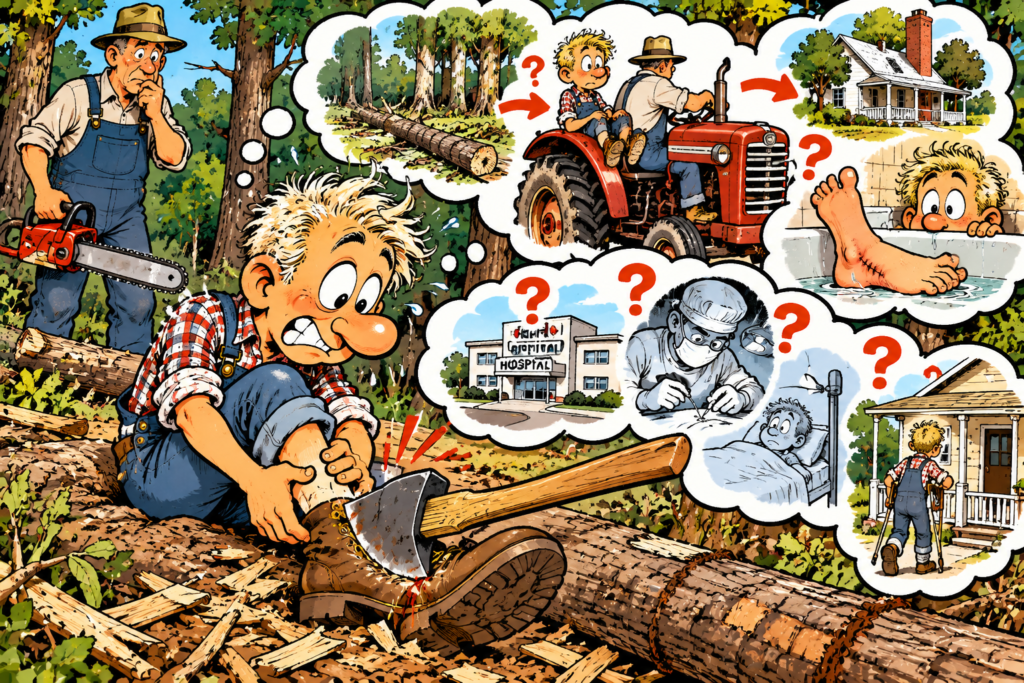
When I was twelve or thirteen years old, I put an axe through my shoe and into my ankle. It took something like fifteen stitches to close the wound, which seems to me like the sort of childhood experience a fellow ought to remember in considerable detail. I don’t.
What I remember instead is a peculiar collection of pieces. I remember the woods where it happened. I remember the poplar tree I was standing on. I remember the axe coming down. I remember riding home on the fender of Daddy’s little Ford tractor with my feet supported on the hydraulic lift arm. I remember sitting in the bathtub at home and seeing the wound for the first time, including little white spots down inside the red stuff that I thought might be bone.
Then the picture starts breaking up. I don’t remember the trip to the hospital. I don’t remember the doctor. I don’t remember getting the stitches. I don’t remember coming home.
And until recently, I hadn’t thought much about any of it for years.
That’s the part that interests me. Not that I hit myself with an axe. Twelve-year-old boys have been finding inventive ways to damage themselves since approximately the invention of the twelve-year-old boy. What interests me is what my mind kept, what it apparently misplaced, and how a story I wasn’t consciously carrying around could suddenly show up again with some of its pieces remarkably intact.
First You Need the Woods
This happened on our farm outside Durham, North Carolina, in the early 1950s. Mother had named the place Rancho Eno. Our property ran along Hamlin Road for perhaps half a mile, and I can still travel that stretch in my mind well enough to give you something resembling a tour.
Starting near Mr. Watson’s pasture, you crossed our driveway and came to a three- or four-acre field. Beyond that was roughly a quarter mile of woods. Farther along stood a packhouse where the builders had stayed while Mother’s new house was being built, a couple of old log tobacco barns, a rent house Daddy owned, the twelve-acre field where I once plowed with our mule Molly, an old tenant or sharecropper house, and finally the Royster property.
The axe episode happened in those woods between the field in front of our house and Hamlin Road. They were the same woods John had once burned down while escaping from a jail Kent Mayton had put him in.
That sentence requires considerably more explanation than this story can afford. For now, John was my brother, and Kent Mayton was a kid from across the road, and somewhere in their history was a jail created in an alcove of branches and dried leaves under a fallen tree, an escape and a fire. I have the story, and eventually it deserves one of its own. What matters here is that the woods grew back, because by the time I was twelve or thirteen Daddy was trying to manage the trees in them.
He was clearing out some of the less marketable trees so the more valuable ones would have room to grow. One of the trees he had taken down was a poplar, and that was where I came into the operation.
Daddy Had the Chainsaw. I Had the Axe.
My job was to stand on the fallen tree and lop off the limbs with an axe so Daddy could use his chainsaw to cut the trunk into cordwood. The wood was destined for Mother’s fireplace in the living room, although we already had a furnace and central heat and therefore didn’t actually require a fireplace to keep from freezing.
Apparently she just liked looking at fire.
Come to think of it, folks still do. People now build houses with heating systems capable of keeping every room at precisely the temperature they want, and then spend a considerable amount of money constructing a large decorative fire in the middle of one wall. Some of the modern ones don’t even require wood. We have managed to preserve the fireplace while gradually eliminating most of the reasons fireplaces originally existed.
I don’t know why that amuses me, but it does. Mother wanted a fire, Daddy wanted cordwood, and Daddy had a boy available who was old enough to swing an axe. That put me on top of the poplar.
I don’t remember how long I had been working before it happened. I don’t remember whether I was tired, whether the limb moved, whether my foot was in the wrong place, or whether I simply made a bad swing. All I know is that one stroke of the axe went through my brogan and into my ankle.
I didn’t see what I had done until we got home.
I Do Remember The Ride
We rode back to the house on Daddy’s little F-100 Ford tractor. I sat on the fender and supported my feet on the hydraulic lift arm.
There is probably something peculiar about remembering that so clearly. I had just buried an axe in my ankle, but my mind saved the seating arrangement.
I don’t remember what Daddy said during the ride. I don’t remember what I said. I don’t know what we did about the bleeding before we left the woods, and I don’t remember whether the trip hurt like hell or whether the excitement had temporarily taken care of that. If I try to supply those details now, I would only be manufacturing a better story than the memory gives me.
But I still see myself on that fender.
At the house they put me in the bathtub so we could get the wound cleaned up, and that’s when I remember actually seeing it. The gash looked more than a quarter of an inch wide. Beneath my extremely tender white skin was a layer of red stuff, and down inside it I could see little white spots that appeared to be bone.
I don’t know whether they actually were bone. At twelve or thirteen I was not qualified to make that determination, and seventy-odd years of additional experience has not turned me into a surgeon. But that’s what I thought I was seeing.
Oddly, I can still see that too.
Then Somebody Apparently Cut the Film
The wound required medical attention, so somebody took me to a hospital. I think it was Watts Hospital in Durham, which would make sense for where we lived and when this happened. I also have some sense that my Uncle Burch may have been involved in getting me there. He and Aunt Marian were living with us at the time. But, that’s as far as I can responsibly take it.
I don’t remember getting into the vehicle. I don’t remember the ride. I don’t remember entering the hospital, waiting for a doctor, having the wound examined, receiving whatever anesthetic they used, or watching anybody put something like fifteen stitches into my ankle. I don’t remember the ride home either.
That seems backward. If you asked me which part of the experience ought to have survived, I would have expected the hospital and the stitches to outrank sitting on a tractor fender. Memory apparently has its own filing system and has not asked for my assistance in designing it.
The axe remains. The poplar remains. Daddy remains. The tractor remains, right down to the hydraulic lift arm under my feet. The bathtub remains, and so do those little white spots in the wound. Then an entire sequence that ought to have been memorable simply isn’t available to me.
Even stranger, for many years none of the pieces seemed particularly available. The whole experience had dropped out of the group of stories I normally tell about growing up at Rancho Eno.
Yet when it returned, it brought a neighborhood with it.
One Memory Seems to Have Neighbors
The woods don’t exist in my memory only as the place where I cut my ankle. They connect to the field in front of the house, Hamlin Road, the packhouse, the tobacco barns, the rent house, the Molly field and the tenant house. They also connect to John burning the woods while escaping Kent Mayton’s jail, which is a completely different episode.
The poplar leads to Daddy managing the woods. Cutting it into cordwood leads to Mother’s fireplace. The tractor connects to a hundred other farm experiences. Uncle Burch and Aunt Marian appear at the edge because they were living with us then.
I don’t have to deliberately assemble those things. Start tugging on one piece and some of the others seem to move.
That doesn’t prove anything about how memory works, and I don’t want to turn one old man’s recollection into a scientific theory merely because I happen to find it interesting. What I can say is that my own memories don’t always seem to return as neat individual files. Sometimes one piece arrives with other pieces attached, and sometimes following one of those pieces takes me into a story I hadn’t been trying to remember at all.
That may be how we eventually get from an axe wound to John burning down the woods while escaping from jail. I didn’t sit down intending to make that connection. The woods made it for me.
And that is where my curiosity starts getting ahead of my knowledge.
What Exactly Was Sitting There All Those Years?
I have no trouble understanding that I forgot details. What bothers me—in the useful sense of bothers—is that I apparently forgot access to almost the entire event while retaining enough pieces for much of it to become available again.
Where were they?
I don’t mean where in the brain. There are people who actually know enough neuroscience to have that argument, and I am not one of them. I mean something more ordinary. If you had asked me a few years ago to list the important childhood injuries I remembered, would this one have appeared? I don’t know. Yet once the axe episode became active again, I could place myself in the woods, on the tree, on the tractor and in the bathtub.
Maybe you’ve had the same damned thing happen. You hear a name you haven’t heard in fifty years and suddenly remember the porch on somebody’s house. You smell something cooking and a kitchen appears. You find an object in a drawer and discover that it is attached to a person you hadn’t consciously thought about in years. The recovered thing doesn’t always arrive alone.
Sometimes what comes back isn’t even what you would have chosen to save.
I got fifteen stitches and can’t remember receiving them.
I remember where I put my feet on the tractor.
Well, I’ll be damned.
Now I’m Going to Accuse You of Something
I think you’ve got some of these.
You have experiences you believe you’ve forgotten because you can’t call them up on command. You may even say, “I don’t remember much about that period,” and be perfectly sincere. But I wonder whether “I can’t retrieve it right now” and “it is gone” are the same thing.
I don’t know that they are.
More importantly, neither do you.
So here’s something I’d like you to try. Don’t sit down and attempt to remember your childhood. That’s too large and too damned much like homework. Start with one odd piece that has survived for no apparent reason: a porch, a tool, a teacher’s hand, the dashboard of a car, a kitchen chair, a particular tree, the smell of somebody’s house. Stay with that one piece for a little while and see what begins attaching itself to it.
Then tell us what happened.
I’m especially interested if the thing that survived seems less important than something you’ve lost. Maybe you remember the wallpaper but not the person talking to you, the trip but not the destination, or where you put your feet while forgetting the fifteen stitches.
Send us the piece. Don’t polish it, and don’t repair the holes. The holes may be part of what makes it interesting.
I want to see what else comes back with it.