
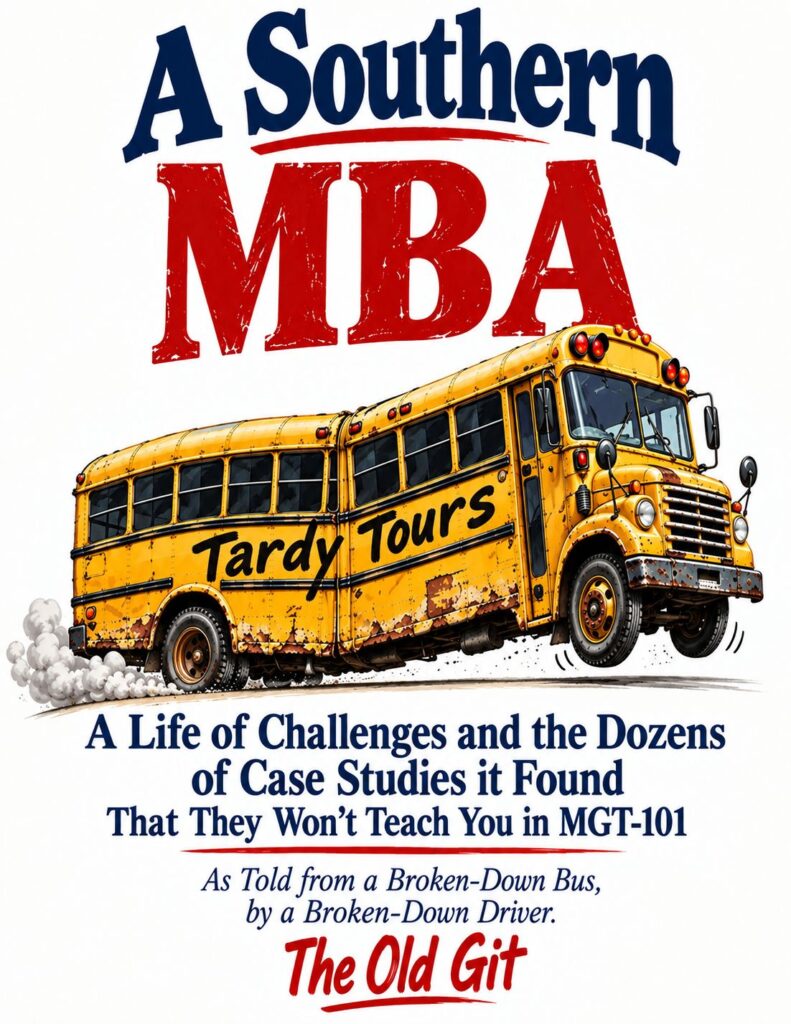
A Southern MBA: An Education Nobody Would Admit to Giving
There was this old fellow who had spent eighty-four years on God’s green earth, and somewhere along the way he had managed to acquire enough business experience to qualify for several respectable careers, provided nobody looked too closely at how he’d acquired it.
He’d been a disc jockey, a taco merchant, a restaurant operator, an accountant, an auditor, a commercial lender, an Internet marketer, and an inventor. He’d bought things, sold things, built things, lost things, and occasionally discovered that the thing he’d just spent three years developing had already been invented by somebody who didn’t know what to do with it either.
Most people would have called that a career without adult supervision. The Old Git called it an education.
And then, at an age when sensible gentlemen are supposed to be sitting on a porch discussing their medications, he decided to tell somebody about it.
The Trouble Started With a Bus
Now, the bus wasn’t exactly what a reasonable person would have selected for a tour of the Blue Ridge Mountains.
It was an elderly Bluebird, yellow in places where the paint hadn’t surrendered, with enough accumulated mechanical peculiarities to qualify as a rolling museum of deferred maintenance. The name painted along its side was Tardy Tours, which was either an unusually candid business name or a warning that the passengers ought to have taken more seriously.
Behind the wheel sat the Old Git, a six-foot-eight collection of long bones, accumulated experience, and opinions that had survived repeated collisions with the facts. He had the relaxed confidence of a man who had already made most of the mistakes available to him and was prepared to invent a few more if the occasion demanded it.
His passengers were an assortment of people who had expected a sightseeing trip.
They were about to receive something closer to a business education, although nobody had thought to warn them, and there was no provision for transferring the credits.
Somebody asked him a question. It may have been about the bus, or his age, or how a man got into so many different businesses without being arrested for trespassing in somebody else’s profession.
Whatever the question was, the Old Git answered it with a story.
And that was the beginning of the trouble.
An Education With No Sensible Curriculum
There was a boy named Red who grew up in North Carolina, where the cotton fields were real, the schoolhouses were small, and the opportunities for getting into something you hadn’t been invited into were practically unlimited.
There was Mrs. Fallaw, a schoolteacher who somehow got that boy interested in underwater cities when he hadn’t yet mastered all the ordinary things available above water.
There was California, where a young man with more ambition than preparation wandered into the radio business among the magnificent lunatics of the 1960s.
There was Texas, where tacos and Glen Bell entered the picture, and where a young businessman made enough money to discover that not understanding your own financial statements was an expensive way to learn accounting.
That particular revelation eventually led him toward Baylor University, which was probably not the route the admissions department had intended.
And there were restaurants. Lord, there were restaurants.
The Old Git seemed constitutionally incapable of passing an empty building without wondering whether somebody might be persuaded to buy food inside it. He had the same weakness for other people’s businesses, particularly when their owners were doing something so magnificently foolish that an accountant could learn from it without risking his own money.
There were jukeboxes, bankers, mortgages, inventions, computers, customers who bought products and refused to use them, and enough financial adventures to make a squirrel’s path through a pecan orchard look like a surveyor’s straight line.
Every story seemed to lead to another.
The passengers had boarded expecting mountains. They were getting an education in human behavior, with occasional views of North Carolina through the windows.
Then Somebody Noticed Something
Now, there was a peculiar feature to the Old Git’s stories.
Things kept turning up in places where they had no apparent business being.
Something learned in a restaurant would reappear years later in an invention. A problem encountered while examining a loan would turn out to have a cousin in an entirely different industry. A childhood experience, apparently forgotten, would wander into a much later undertaking and make itself useful without so much as knocking on the door.
It was as though the Old Git had spent his life stuffing things into a kitchen drawer, and every time he pulled out an extension cord, three other cords came with it, along with a bottle opener, a dead flashlight, and something nobody in the household would admit to owning.
The passengers began to notice.
So did the Old Git.
And somewhere among the stories, another question began to emerge.
Where the hell did that idea come from?
Not who deserved the credit. Not whether the idea was clever. Not even whether it worked.
Where did it come from in the first place?
Because the Old Git had never received one of those magnificent flashes of inspiration that people are always describing in books about successful inventors.
What he’d received was invoices.
And encounters. And problems. And mistakes. And bits and pieces of things that seemed utterly unrelated until, years later, they weren’t.
He’d even invented a new spectator sport called NimBall, an undertaking involving roller skates, a banked track, unusual equipment, and enough moving parts to make an insurance underwriter reach for the aspirin.
But where had that come from?
That question was considerably harder to answer than explaining how the game was supposed to be played.
A Southern MBA, With No Diploma and Very Little Mercy
And so the Old Git’s stories acquired a name.
A Southern MBA.
Not the sort awarded by a university, with a handsome diploma and a bill for tuition. This one had been earned in restaurants, radio stations, accounting offices, banks, factories, and places where people with excellent intentions were discovering the consequences of their decisions.
The case studies were real. The lessons were frequently expensive. The examinations generally arrived before anybody had announced what the subject was.
And there was no guarantee the student had learned a damned thing.
The Old Git was not particularly interested in presenting himself as a business genius. A genius, after all, ought to have been able to avoid repeating certain mistakes. His qualifications were more modest: he’d been there, he’d seen things, he’d tried things, and he’d survived long enough to tell the stories.
Sometimes he’d been right. Sometimes he’d been spectacularly wrong. And sometimes he’d been right so early that it didn’t do him a bit of good.
There was no shortage of material.
What began to interest his passengers, though, wasn’t simply what happened to Red as he grew older. It was how the experiences seemed to accumulate, how one thing connected to another, and how a lifetime of apparently disconnected adventures might eventually produce something nobody had set out to invent.
The Old Git had some ideas about that, too.
Naturally, he couldn’t leave well enough alone.
The Book Is Still Being Argued Over
The stories have now found their way into a manuscript, and that manuscript has reached the desk of the Lovely Celeste, who has the considerable distinction of being both the Old Git’s wife and a woman who knows where a good many of the bodies are buried.
An ordinary editor can question a sentence.
Celeste can question the entire event, identify the witnesses, and explain why the Old Git’s recollection has improved considerably with age.
This is an advantage to literature, if not necessarily to the author.
So A Southern MBA is not on sale yet. The manuscript is being examined, corrected, argued over, and prepared for the possibility that somebody besides the Old Git’s immediate family might actually want to read it.
Meanwhile, some of the stories have escaped onto this website, where they are available without purchasing a bus ticket or signing a waiver.
The book itself is a journey through an extraordinary assortment of ordinary human experiences, told by a fellow who has had more than his fair share of them.
There are business stories, childhood adventures, inventions, unlikely encounters, spectacular miscalculations, and occasional moments when something worked out so well that even the Old Git was suspicious.
There is also a question that keeps following the bus.
Where the hell did that idea come from?
The Old Git has been working on an answer.
Whether he’s found one is another matter entirely.
But, dear hearts, after eighty-four years, he’s accumulated one hell of a lot of places to look.
And Tardy Tours hasn’t reached its destination yet.
Want to Know When the Book Is Ready?
Can’t Wait? Start Here.
What If I Hadn’t Sold the Damn Accounting Practice?
The Jukebox Man Who Bought the Mortgage
The Customers Who Bought My Product and Wouldn’t Use the Damned Thing