
Two Belvins, Two Stores, and One Road Out of Town
Now, dear hearts, before we get young Red anywhere near a girl, we have got to straighten out the geography, because there were two Belvins and two stores along this particular stretch of northern Durham, and confusing them is the sort of thing an Old Git can do sixty-some years later while being absolutely certain he knows what he is talking about. One Belvin had a grocery store at the intersection of Roxboro Road and Old Oxford Highway. Another Belvin, Sheriff Belvin, owned Catsburg farther out Old Oxford Highway where Hamlin Road turned off. They were related, as half the people in that part of Durham County seemed to be related if you shook the family tree hard enough, but they were not the same man and these were not the same stores.
Belvin’s Grocery, the first one, had seen better days by the time Red was riding back and forth through there. The business was gone, the building was run down, and it had that weary look old country stores acquire when commerce has departed but nobody has yet gotten around to informing the building that its career is over. The place still had one important function, though, because the Durham city bus line, operated by Duke Power Company in those days, ended its route there. The bus came out from town, swung around the circle in front of the old store, took on or discharged its passengers, and went back the way it had come. That was where Red got on and off, and if you were a farm boy without an automobile, that turnaround was considerably more important than any airport terminal.
The bus could take him toward Durham, where there were stores, movies, Barfield Youth Center, music and girls. Old Oxford Highway could take him the other way, toward Duke’s Chapel Methodist Church, Catsburg, Hamlin Road, the Eno River, the Ward farm and all the country Red knew as ordinary because he had not yet lived long enough to discover that ordinary places eventually become the places you would give almost anything to walk through once more.
That old bus circle was not merely the end of a route. For Red, it was where one world turned around and became another.
Catsburg, Which Really Did Have Cats
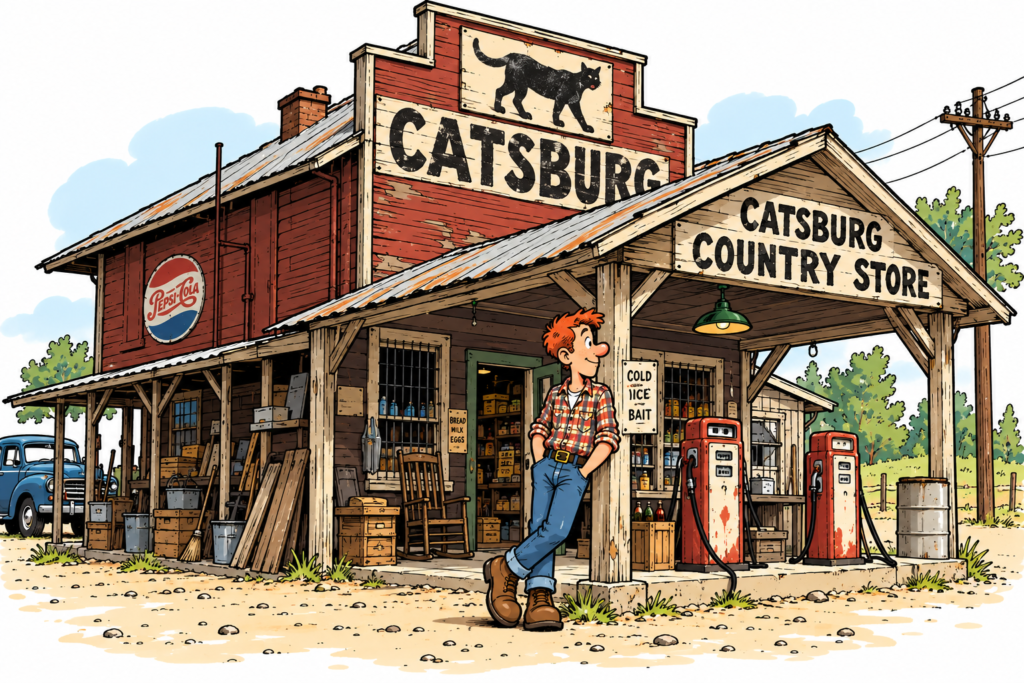
Travel farther along Old Oxford Highway and eventually you reached the intersection with Hamlin Road, and there sat Catsburg, which belonged to the other Belvin, Sheriff Belvin. Catsburg was still very much alive when Red knew it. Loretta Reagan, one of Red’s classmates, had a father who rented the store from the Sheriff and ran it, so this was not some abandoned landmark that Red later learned about from a history book. It belonged to the working geography of his childhood, a place where people stopped, bought things, exchanged news and generally kept track of what the rest of the county was up to.
Sheriff Belvin liked cats and fed enough of them around there that Catsburg became the name of the place, which is a method of civic nomenclature I believe we ought to restore. You did not need a development corporation, a focus group, six lawyers and a fellow from Atlanta charging three thousand dollars to devise a brand identity. If a man owned the store and fed a passel of cats around it, people called the place Catsburg, everybody knew what you meant, and civilization moved right along without issuing a press release.
The Sheriff also liked baseball enough to maintain a ball field beside his house. Red does not remember ever meeting him, but Daddy certainly knew of him and had become interested in one particular feature of the Sheriff’s political career. Daddy had heard that Belvin spent something like eight thousand dollars getting himself elected to a two-year office that paid around two thousand dollars a year, and this caused Daddy to perform one of those calculations country people could make without the assistance of an MBA.
Eight thousand dollars went out, four thousand dollars came back, and the fellow who had spent the eight was apparently pleased with the arrangement.
Daddy never explained the mystery, at least not to Red. He merely wondered aloud how that arithmetic was supposed to work, and Red filed the question away with all the other evidence suggesting that grown people possessed secrets they were in no particular hurry to explain to children. Farmers understood money rather directly because a cow, a tractor, a crop and a bank note had no respect whatever for creative accounting. If you spent eight dollars to make four, Daddy considered it possible that somewhere in the transaction there was a detail worth knowing.
The Old Git still doesn’t know the detail, so we shall leave the Sheriff in possession of his office, his baseball field, his cats and his arithmetic and continue down the road.
The Country on the Other Side of Catsburg
Hamlin Road turned off at Catsburg and ran through land associated with the Hamlin family, who had once owned a great deal of that country before the War of Northern Aggression rearranged fortunes along with everything else. Over time the land was broken up, and eventually a piece of that old country became the Ward farm where Red grew up. Behind the farm ran the Eno River, and across the river Fairntosh backed up to us, so all of these names that now sound like entries in a county history were simply the geography a boy moved through without thinking there was anything particularly historical about it.
Duke’s Chapel Methodist Church sat on Old Oxford Highway and belonged to that same world. The Ward family went there, and so did Mrs. Rosa Belvin, Sheriff Belvin’s wife. Red remembers her not as the Sheriff’s wife so much as one of those grandmotherly country women who seemed to possess a natural authority requiring neither office nor title. She was nice to you in a way that could make you feel completely welcome while she quietly learned who your parents were, whether you behaved yourself, whether you had been properly fed and, if circumstances required it, whether you might be suitable company for a granddaughter.
Those women could conduct an investigation without anybody realizing there had been an investigation. You would think Mrs. Belvin had merely asked after your mama, and by the time the conversation ended she knew enough about you to determine whether you ought to be trusted with livestock, garden tools or unmarried female relatives.
Apparently Red passed.
Because Mrs. Belvin had a granddaughter visiting from San Diego.
Her name was Carolyn Kline.
Glory Be, California Has Sent a Girl
Now San Diego was not simply another city when Red was thirteen or fourteen years old. California was way out yonder, somewhere beyond the ordinary limits of a North Carolina farm boy’s universe, and most of what he knew about it had arrived through movies, magazines, radio and television. California seemed to be a land of sunshine, palm trees, convertibles, movie stars and people who apparently never spent Saturday afternoon digging a posthole.
Into this exotic vision came Carolyn Kline, Mrs. Belvin’s granddaughter, probably a year younger than Red.
Mrs. Belvin introduced them.
I would like to give you a magnificent account of that first meeting, because any respectable Jack Tale deserves one. Carolyn ought to come floating across the Duke’s Chapel churchyard with sunlight dancing in her hair while bluebirds settle into the dogwoods, the Methodist choir suddenly discovers rhythm, and three chipmunks emerge from the shrubbery doing choreography ordinarily unavailable to woodland animals. Red ought to stand there struck dumb while some celestial voice announces that California has arrived in Durham County and would he kindly tuck in his shirt.
Unfortunately, none of that survives in memory.
The Old Git remembers Carolyn, but he does not remember the first words they exchanged or precisely where they were standing when Mrs. Belvin performed the introduction. We could invent those things and make a prettier story, but then it would cease to be Red’s story and become something manufactured sixty years afterward by an elderly gentleman with access to adjectives.
What happened next, however, stayed.
Red and Carolyn began writing to each other.
The United States Postal Service Takes Up Courtship
Now then, members of the congregation below a certain age may require some explanation of this procedure, because courtship by mail involved a degree of patience that would today qualify as an altered state of consciousness. Red would sit down with a piece of paper and a pen and actually compose a letter by hand. There was no delete key, no spell-check and no electronic schoolmarm materializing beside the page to inform him that his prose might be more concise if he removed every trace of his personality.
When he finished, he folded the pages, put them into an envelope, addressed the envelope, stuck a stamp on it and licked the flap. We used our tongues in communications technology in those days, dear hearts, and somehow the Republic survived. Then Red entrusted this damp little bundle of adolescent thought to the United States government with instructions, represented by the address and the stamp, to haul it clear across the country and deliver it to a girl in San Diego.
After that came the part modern communications have almost eliminated.
You waited.
You did not know whether Carolyn had received it. You did not know whether she had opened it, whether she was answering it or whether she had shown some particularly embarrassing passage to three girlfriends who were at that very moment rolling around on a California bedroom floor laughing themselves into respiratory distress. There was no Carolyn is typing. There were no bouncing dots promising imminent revelation. Red had a mailbox, and every now and then something from California appeared in it.
I cannot remember what she wrote.
That is the damnedest part of this whole story.
Little Hearts
Carolyn’s letters must have contained hundreds and eventually perhaps thousands of words. She told Red things about her life, and Red presumably told her things about his. Whatever those things were mattered enough at the time for two young people separated by an entire continent to sit down, write them out by hand, find stamps and send them back and forth.
The Old Git cannot retrieve a single sentence.
But Carolyn dotted her i’s with little hearts.
Those I remember.
Now, dear hearts, a fourteen-year-old boy receiving a letter from a girl does not approach such evidence with the detached caution of a laboratory scientist. Red did not examine one of those hearts and say, “We must be careful here. This may simply represent Miss Kline’s habitual orthographic style, and further evidence will be required before drawing conclusions concerning romantic intent.” He saw a little heart over an i, and whatever machinery nature installs in adolescent boys commenced turning over.
There were X’s and O’s in those letters too, which did nothing whatever to restore scientific objectivity.
Whether Carolyn dotted every i she ever wrote with a heart, including those in homework assignments and notes to her grandmother, I have no earthly idea. Red was not conducting a controlled experiment. A pretty girl in California was writing to him, and her i’s had hearts over them. That was sufficient data for the purpose at hand.
Saturday Night at Barfield
When Carolyn was in Durham, Red took her dancing at Barfield Youth Center, and if we are going to understand why that mattered we have to enter another vanished little world. Barfield was a modest brick youth center where teenagers could gather, listen to records, dance, drink Coca-Cola and undertake the enormously complicated business of being young in the presence of other people who were equally young and pretending to understand what they were doing.
There might be twenty or thirty teenagers there on a Saturday night. There was a little booth or cubicle with a turntable connected to the public-address system, and sometimes Red worked the records, which gave him temporary authority over the emotional climate of the building. Put on something the kids liked and bodies moved onto the floor. Pick badly and everybody suddenly developed an urgent interest in Coca-Cola. Disc jockeying taught Red an early lesson in management: authority is granted conditionally by the governed, and they can abandon you before the record reaches the second chorus.
The music in those years was changing. Rhythm and blues, rockabilly and the thing becoming known as rock and roll were creeping into the lives of young people while respectable adults looked on with the expression ordinarily reserved for discovering termites in the sanctuary. Teenagers moved differently to it, listened differently to it and claimed some little piece of the culture as their own.
And Red danced with Carolyn.
I cannot tell you what record was playing. I cannot tell you what she wore or what they talked about between dances, and I am not going to manufacture a moonlit conversation simply because the story would look handsome wearing one. Red remembers being there with her, and he remembers dancing, which is enough to tell us that the girl who had first existed at the far end of an envelope had become real enough to hold in his arms while music played.
For a farm boy from out Old Oxford Highway, that was quite sufficient excitement for one evening.
Then Life Did What Life Does
Carolyn went home to San Diego, and for some period afterward the letters continued traveling between California and North Carolina. Then the correspondence faded away. There was no quarrel that the Old Git remembers, no dramatic farewell and no villain who needs to be dragged into the final act and exposed before the congregation. Two young people simply continued growing up in places thousands of miles apart, and life began adding other people, other responsibilities and other roads.
Years later, Red tried to find Carolyn again.
That was harder before the internet. A name and an old city did not open the world the way they do now, and somewhere along the line he simply lost her. She went on into a life he knew nothing about, while Red went on into his, and that is one of the quieter ways people disappear from us. Nobody dies. Nobody slams a door. Nobody even realizes that the last letter is the last letter while it is being written.
One day you merely discover that somebody who once occupied a lively little corner of your world has become a memory.
I have wondered about Carolyn from time to time. I hope she had a happy life, and I suspect Mrs. Rosa Belvin, wherever grandmotherly country ladies go when their matchmaking days are finished, would be pleased to know that the introduction mattered even though it did not produce whatever future she may or may not have imagined when she brought those two children together.
What the Old Git Found in the Junk Drawer
What interests me now is not that Red had a youthful romance. Boys and girls have been discovering one another since considerably before anybody thought to build Catsburg, and no great scientific principle can be extracted merely from the fact that a redheaded North Carolina boy became interested in a girl from California.
What interests me is the wreckage left behind.
Look at how much of that world is still lying around inside the Old Git. There is Belvin’s Grocery, shabby and abandoned at the end of the Duke Power bus route, with the bus swinging through its turnaround before heading back to Durham. There is Old Oxford Highway carrying Red out through the country. There is Catsburg at Hamlin Road, alive and operating, with Loretta Reagan’s father behind the counter and Sheriff Belvin somewhere nearby with his cats, his baseball field and his arithmetic that bothered Daddy. There is Duke’s Chapel, Mrs. Belvin, the Eno behind our farm and Fairntosh across the river. There is Barfield, a turntable, teenagers dancing and Carolyn visiting from San Diego.
Some of those memories are clear. Some are fragments. Some have probably changed around the edges simply because human memory is human memory, and the Old Git has no intention of claiming documentary precision for things he experienced when Eisenhower was President.
But the strangest selection is Carolyn’s letters.
The words are gone.
The hearts survived.
Where the Hell Did That Come From?
Now we arrive at the place where the Old Git starts worrying at the thing, because the temptation is to say that the hearts survived because they were emotionally important and then march triumphantly off as though we had explained something. We haven’t. We have merely put a respectable necktie on the question.
Why should that tiny visual detail remain when the information in the letters disappeared? Perhaps novelty mattered. Perhaps repetition mattered because Carolyn made the same little mark over every i. Perhaps emotion attached itself to the mark. Perhaps the mark became associated with Carolyn herself until seeing it and thinking of her became almost the same mental act. Perhaps all of those things bumped together and made something sturdy enough to survive sixty years of other experiences piling on top of it.
I do not know, and that ignorance belongs in the story because this whole Old Git enterprise becomes considerably less interesting the moment we start pretending to know things merely because we can manufacture a plausible explanation.
What I do know is that Red lived inside a world he thought was ordinary. He rode a Duke Power bus from a dilapidated grocery store. He traveled Old Oxford Highway past little country landmarks whose names carried generations of local history. He went to a Methodist church where a kindly grandmother decided he ought to meet a girl from California. He danced with that girl at Barfield and then waited for her letters to cross the country.
Most of what they wrote to each other disappeared.
But more than sixty years later, the Old Git can still see those little hearts sitting over Carolyn’s i’s.
Maybe that is what memory does. It does not preserve our lives as stories with all the important parts underlined. It keeps a bus turnaround and loses a conversation. It keeps Daddy puzzling over a sheriff’s arithmetic and loses the names of people standing nearby. It keeps the feel of a dance and throws away the song. It can discard a thousand words somebody wrote especially for you and preserve the silly little mark she put above one letter.
And maybe that is why the Old Git keeps poking around in this old mental junk drawer in the first place. You never know what insignificant little thing you are going to pull out, or what other things will come tumbling after it once you do.
This time it was a heart over an i.
And damned if half of Old Oxford Highway didn’t come out with it.
Now Go Poke Around in Your Own Junk Drawer
Here’s where you come into this, dear hearts, because the Old Git has a suspicion that Carolyn’s little hearts are not peculiar to him. Somewhere in your own head there may be some equally ridiculous little scrap that survived while the supposedly important stuff packed its bags and departed years ago.
Maybe it is the smell of your grandmother’s kitchen, the sound of your father’s car coming up the driveway, something somebody always kept in a shirt pocket, the pattern on a dress, a nickname nobody has called you in fifty years, the feel of a particular front porch under your bare feet, or some tiny mark somebody once made on a letter. You may have forgotten what happened before it and what happened afterward, but that one fool thing is still sitting there as fresh as Tuesday.
That’s what the Old Git wants. Not necessarily the whole story. Don’t worry if you don’t have one. Give us the scrap that survived. Tell us what the thing is, who or what it reminds you of, and anything else that comes tumbling out when you poke at it. A sentence is enough to start with. We’ll worry at it from there.
And if this story made you think of somebody else who has a mental junk drawer full of peculiar old treasures, send this story to them and ask them one question:
What little thing did you remember when everything around it disappeared?
If something comes loose, send it to the Old Git. You don’t need a polished story, and you don’t need to know why the memory stuck. That’s what we’re here to worry at together.
The Puddle has room.