
Baby Brother Jim grew up, as baby brothers have an aggravating habit of doing, and somewhere along the way became just Brother Jim. Jimbo, as he preferred to be called, had spent part of his young manhood as a genuine flower-child rock-and-roll bass player before wandering off into computers, which in those days were mysterious enough that anybody who understood one could apparently charge whatever he pleased.
Jimbo eventually moved to Raleigh, North Carolina, which was growing like somebody had fertilized it.
Growing cities need things. They need roads and sewer lines and shopping centers and subdivisions with names suggesting the trees that were cut down to build them. Most particularly, they need water, and Raleigh had developed itself a powerful thirst.
Fortunately, the Federal Government Had a Cure
Fortunately, the federal government knew how to cure that.
The cure was a dam.
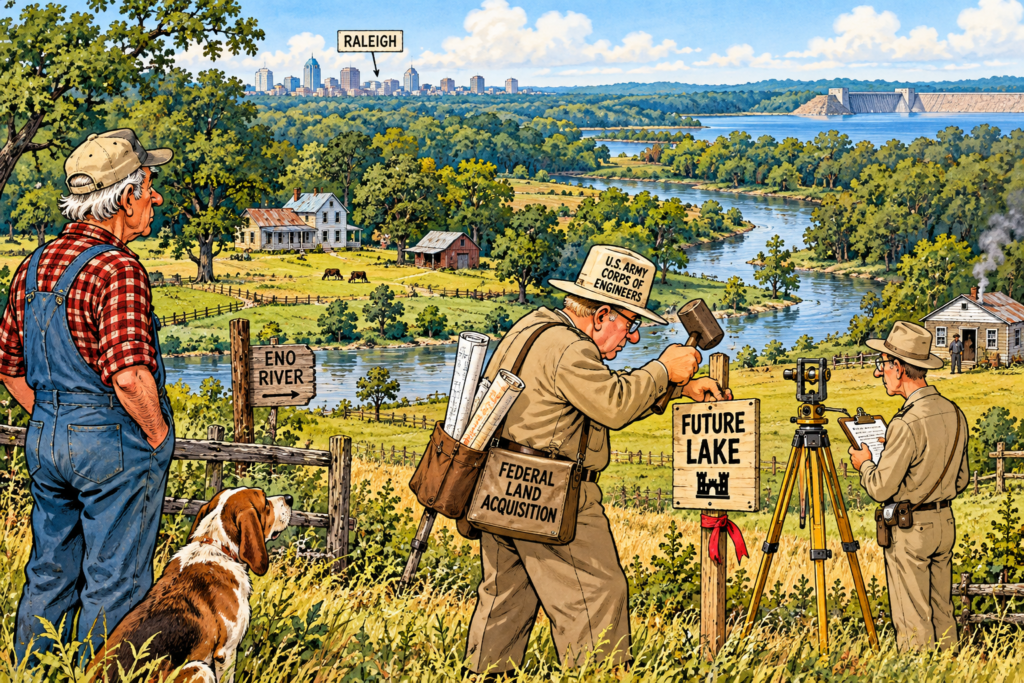
They were going to dam the Neuse River north of Raleigh and create a great big reservoir with the handsome name Falls of the Neuse. That sounded almost poetic. You could imagine waterfalls and herons and perhaps a fellow in a canoe contemplating nature.
What the name did not advertise quite so prominently was that the water wasn’t planning to stay politely at the Falls of the Neuse. It was going to back itself up into other people’s rivers, creeks, bottomland, woods, roads, houses and farms. Among the waterways invited to participate without being consulted was our old friend the Eno River.
And sitting alongside the Eno was Ma and Pa’s farm.
Now, this was not some patch of dirt the family had bought because somebody in Raleigh had printed a brochure about country living. This was the country Red had grown up in. There were hundreds of acres of lowgrounds along that river, the kind of bottomland farmers had valued for generations because the river had been improving the soil long before anybody invented a Department of Anything.
Then along came the United States Government.
The government had decided where the water was going to go, and once the government has decided that your farm is going to become part of a lake, there isn’t much point in arguing that corn won’t grow underwater. The question was no longer whether Ma and Pa were going to lose the land. The question was how much the government was going to pay them for it.
The Watsons Got More
The Feds made an offer.
Ma didn’t like it.
There was a particular reason she didn’t like it, and that reason lived next door. Art and Anne Watson had a farm adjoining Ma and Pa’s, and according to Ma, the Watsons were getting more money for their land. Not merely more money in total. More per acre. Ma was convinced that she and Pa were losing more land, and better land, and somehow the Watsons had come out ahead.
This offended Ma’s sense of justice, economics and neighboring all at the same time.
There was, however, a wrinkle.
Mr. Watson worked for Central Carolina Bank, but before that he had worked for the State of North Carolina doing essentially the same sort of thing that was now being done to him: acquiring people’s land. The fox had not merely been put in the henhouse. This particular fox had previously worked for the Department of Henhouse Acquisition.
Art Watson knew the system.
Ma knew Red lived in Charlotte and had a lawyer, which in family reasoning was apparently close enough to knowing the system, so she came to Red and wanted to know what could be done.
Red did not know.
That has never prevented him from finding somebody who did.
Red Went to See a Lawyer
He went to his lawyer in Charlotte and laid out the problem: the federal government was taking his parents’ land for the reservoir, they had made an offer, Ma believed the neighboring Watson farm was getting a better deal, and she wanted to know what recourse they had.
The lawyer explained it.
If Ma and Pa believed the land was worth more than the government was offering, they could refuse the offer. They could challenge the valuation, go through the legal process, and prove that the property was worth more. As Red understood the lawyer’s advice, they were not risking having the original offer reduced merely because they challenged it.
Well now.
That seemed useful.
Red carried this intelligence back to Durham and delivered it to Ma and Pa. Here was the answer to the question Ma had asked. The Watsons knew how the machinery worked. Now Ma and Pa knew how it worked too. If they believed the government was shortchanging them, they had a way to fight for more.
Ma and Pa considered this valuable information carefully and then did absolutely nothing with it.
They took the government’s offer.
The government took the land.
And Ma and Pa complained for the rest of their lives about Art and Anne Watson getting more money per acre than they did.
There is a particular kind of family grievance that does not require a remedy. In fact, a remedy can be downright inconvenient, because accepting one may deprive everybody of a perfectly good grievance. Ma had asked Red what could be done. Red had gone to a lawyer and found out. Ma and Pa then declined to do it, thereby preserving the Watson matter in excellent condition for future discussion.
Then the Land Was Gone
The transaction itself was less amusing.
Pa lost his hundreds of acres of lowgrounds. When it was finished, he had approximately eighty acres left.
And the taking did not stop at property lines drawn on somebody’s survey.
Sylvester lived down there too.
Sylvester was the tenant farmer who had been part of Red’s childhood world on that farm, the same Sylvester who tended crops, raised hogs and cattle, and supplied material for more than one story long before anybody in Washington decided the place ought to hold drinking water. His house stood in the area being taken.
So Sylvester had to move.
That is the part hidden inside a phrase like land acquisition. On a government document, acreage changes ownership. On the ground, somebody’s house is standing where the government has decided water will be.
Sylvester moved into town.
Years passed, as they do, and the farm Red had known became a different place. Where there had been lowgrounds there was government land and eventually water. Pa was left with his eighty acres. The Watson settlement remained available whenever Ma needed something fresh to be mad about. Raleigh got its reservoir.
Where the Story Stops Being Funny
And then the story of Sylvester went somewhere no tale like this ought to go. Years later, Sylvester went to jail for shooting and killing his own son while he was drunk. The son Red had known and played with when they were boys.
There isn’t a turn in the story for that, and there shouldn’t be. You can make sport of Raleigh’s thirst, federal paperwork, a government land grab, Ma’s everlasting grievance, and even the peculiar human ability to ask for advice and then ignore it.
But eventually you come to a place where the storyteller ought to quit performing.
The old farm was changed. Hundreds of acres were gone. Sylvester’s house was gone. The boy Red had played with was gone. And somewhere downstream, Raleigh had its water.