
There was this young fellow named Red who, sometime around 1967, found himself driving every morning from Simi Valley over the Santa Susana Pass and down into the San Fernando Valley to work in a factory making resistors for what everybody there called the Manned Space Program. Red had arrived at this lofty position by answering a classified advertisement in the Mensa monthly newsletter, which is probably not the usual way America selected the people responsible for keeping its spaceships in the sky, but it worked in his case.
The general manager was a Mensa member, too, and told Red that had something to do with hiring him. Red accepted this explanation at the time because it was considerably more flattering than the explanation The Old Git came up with later, which was that the man may have wanted somebody young, agreeable, and ignorant enough to do what he was told. There are reasons for that second theory, Dear Hearts, but they belong to another story. For the moment, all you need to know is that Red was made head of Quality Control, had two assistants working under him, and possessed approximately enough knowledge of quality control to recognize the words when somebody said them slowly.
The factory itself did nothing to suggest that Red had joined the leading edge of the Space Age. It was a one-story red-brick building with a flat tarpaper roof in one of those mixed residential and industrial stretches of the San Fernando Valley that didn’t strike him as worth remembering. Inside, rows of production lines ran beneath hanging fluorescent fixtures, and much of the equipment sat on worktables made from plywood, chipboard and lumber that looked as though somebody had cleaned out the scrap pile behind a construction site. Red later worked in a popcorn-popper factory in Manchester, Kentucky, that looked more like a place where serious manufacturing occurred, but nobody at the popcorn-popper factory claimed its products were going into spaceships.
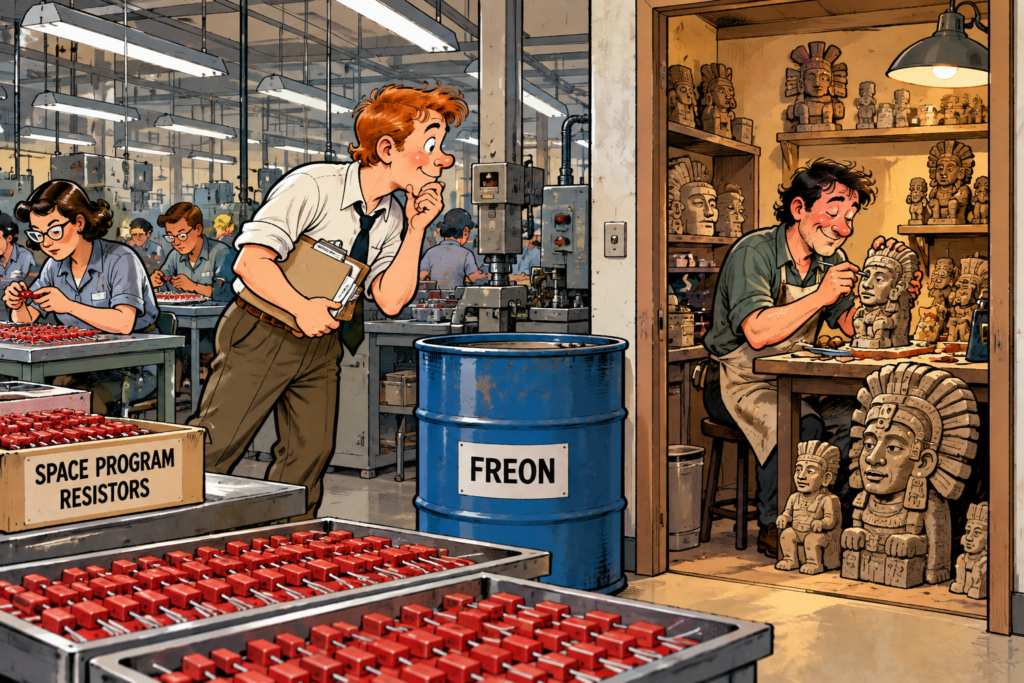
Quality Control occupied its own portion of this establishment. There were rows of plywood tables where inspectors examined and rated the little resistors, along with test ovens, humidity ovens and other equipment Red used to put samples through prescribed trials before handing them to the people who actually knew what they were looking at. The resistors themselves were little red plastic bars, perhaps as thick and tall as the top of a book of matches and about two-thirds of a matchbook long. Red remembers a V-shaped channel running along them for the resistive material, with leads coming out, and his understanding was that they would eventually be adjusted to the resistance the customer required and then sealed.
He didn’t spend much time studying how they were manufactured. He had tests to run, paperwork to tend, two assistants to supervise and a family to support on a paycheck that wasn’t doing an especially enthusiastic job of supporting one.
Beyond Quality Control stretched the factory floor, with line after line of people and machinery working under those fluorescent lights. Among the sights The Old Git still remembers were fifty-five-gallon metal drums standing open and full of Freon. At one stage of the process, strings of resistors clipped together would simply be lowered or dropped into the Freon to chill or clean them. Nobody put on a moon suit. Nobody summoned an environmental engineer. There was the barrel, there was the Freon, and in went the resistors. It was 1967, and apparently the atmosphere had not yet hired a lawyer.
If you continued through all those rows of tables and machinery, past the resistors and the ovens and the barrels of Freon, you eventually reached a little walled-off room in a back corner of the factory. That room belonged, in a practical if perhaps not a real-estate sense, to a fellow about Red’s age, maybe upper twenties or lower thirties, whose regular job was molding the bodies used to make the resistors.
He had another line of work.
The Ancient World Was Just Past the Production Line
Red first heard about the fellow’s sideline from the other employees. Nobody lowered his voice when mentioning it, and nobody suggested Red should pretend he hadn’t heard. The fellow himself wasn’t secretive. He had taken that little room in the back and turned it into a workshop where, in addition to whatever he did for the resistor company, he designed molds for decorative statuettes of the sort that were being sold in gift shops around Los Angeles.
At the time, Red would probably have called them Mayan or Incan because those were about the only two useful words he possessed for anything that looked ancient and came from somewhere south of Texas. The Old Git is no better qualified today to tell you what civilization the figures were supposed to represent, and after nearly sixty years he is not about to award them archaeological credentials they didn’t have when they were new. They looked ancient. They looked exotic. They looked like something you might put on a shelf and tell your neighbors came from somewhere more interesting than the San Fernando Valley.
And they looked good.
Ever discover that the thing you needed to make an idea work already existed in somebody else’s shop, kitchen, office or factory?Tell The Old Git what happened.
Red went into the fellow’s little shop once. He doesn’t remember conducting an inspection or asking many questions, because he wasn’t particularly interested in how the enterprise worked. The fellow was matter-of-fact about it and showed off some of his pieces. They stood perhaps six, eight, ten inches high and had the appearance of jade, a deep green with flowing streaks of white running through them. Whatever material he was using, it wasn’t the ordinary red stuff being molded into resistor bodies out on the production floor.
Red thought they were impressive enough that he wanted one.
Unfortunately, Red Was Also Practicing Poverty
The fellow sold the statuettes. He told Red so himself.
Red thought they were impressive enough that he would have liked to buy one. Unfortunately, admiration and purchasing power were not on speaking terms at that particular point in his life. He had left his previous job in Simi Valley, this one didn’t pay much, and keeping the family’s head above water was using up most of the available resources. When the household budget has already begun examining the grocery bill with suspicion, bringing home a ten-inch imitation pre-Columbian deity requires a quality of salesmanship Red apparently did not possess.
So he admired the fellow’s work and kept his money.
He also thought the fellow had a pretty good sideline going. His only reservation, as he remembers it, was that, if it had been his operation, he probably would have put it somewhere other than inside the factory where he worked. Red had already been in enough businesses to understand that keeping your enterprise and your employer’s enterprise in separate buildings prevented certain conversations about whose electricity, machinery, time and floor space were being used.
But Red didn’t know what arrangement this fellow had with management, and The Old Git doesn’t know today. The operation was too well known to call it clandestine. The employees knew. The fellow himself talked about selling the pieces. Red got the impression that some sort of accommodation had been reached, but he doesn’t know that. Perhaps the fellow possessed skills the factory particularly needed. Perhaps management simply tolerated his sideline. Perhaps there was an arrangement Red never heard about.
The Old Git has learned not to improve an old story by filling its empty spaces with facts that aren’t there.
What matters is that the little factory contained two enterprises. One was making components for the future. The other was manufacturing the past.
Spaceships Out Front, Ancient Gods in Back
That is the part that has grown funnier with age. In 1967, Red didn’t walk out of that little room thinking he had witnessed some grand principle of entrepreneurship. He didn’t make a note for a book he might write when he was eighty-four. He didn’t stand beneath the fluorescent lights stroking his chin and contemplating the efficient reuse of productive capacity. He looked at some handsome statuettes, wished he could afford one, thought the fellow had himself a pretty good sideline, and went back to Quality Control.
But look at the place through The Old Git’s eyes now.
Out on the factory floor, America was in the middle of the Space Age. Men were being trained to ride rockets. Engineers were trying to solve problems that hadn’t existed until human beings decided the Moon looked insufficiently trampled upon. Somewhere in that enormous undertaking, according to what Red had been told, there was a need for the little resistors coming out of this cheap-looking red-brick factory in the San Fernando Valley.
And in the back corner, using skills acquired to serve that future, one fellow was busy manufacturing the ancient past.
There is something almost perfect about that. He didn’t need to invent molding. He already knew how to do it. He didn’t need to learn how to make molds because that was part of what made him useful to the resistor company. He didn’t need to begin by buying a factory because every morning he reported for work inside one. What he needed for his little enterprise was a different idea for what those abilities could produce, some molds of his own design, apparently some different material to give his figures that streaked jade appearance, and somebody willing to buy the finished pieces.
Whether the company charged him for anything, gave him permission, tolerated him, traded space for skills, or simply decided not to ask troublesome questions is something Red never learned. That uncertainty matters because there is a large moral distance between borrowing somebody else’s factory without asking and making an arrangement with somebody who owns a factory. The Old Git isn’t going to move the fellow from one side of that line to the other merely because it makes a cleaner business lesson.
The interesting part is that the line exists at all.
Red Didn’t Bring Home a God
Most of us, when we think about making something, begin by listing what we don’t have. We don’t have the building. We don’t have the machine. We don’t have the money for the machine. We don’t know how to perform one of the processes. We don’t have enough work to keep an expensive piece of equipment busy. By the time we’ve finished listing everything necessary to make the first one, we’ve occasionally talked ourselves out of making anything.
The fellow in the back room had apparently started from another direction. He knew how to make molds because he was already making molds. He worked around molding machinery because that was already his trade. Somewhere in that combination of skills, equipment and opportunity he saw that the same general capability used to help manufacture a little red electrical component could also produce something a customer might set on a coffee table.
Red didn’t learn that as a business lesson that day. That’s important. He merely encountered it. He encountered a cheap-looking factory making sophisticated things, a man whose job skill had more than one use, a business living by some arrangement Red never understood inside another business, and a product he liked well enough to want but couldn’t afford. Then he went back to work.
Nearly sixty years later, The Old Git can look backward and recognize something Red simply carried away without noticing. Sometimes the first question behind a new enterprise isn’t What do I need to build? It is Who already has what I need, and is there some honest arrangement we can make?
That question can lead to contract manufacturing, rented equipment, shared kitchens, borrowed expertise, idle machinery put back to work, or arrangements neither party would have thought of until somebody asked. It can also lead to trouble if the word honest gets misplaced, which is why it belongs in the question.
Red didn’t ask it in 1967. He didn’t have an idea that needed a factory. He just knew there was a fellow in the back corner of his who did.
And while one part of that little red-brick building was helping America reach toward the Moon, the fellow in the back room was turning out ancient gods for the living rooms of Los Angeles.
Red never did get one.
But apparently he brought something home after all.