
Maddie
There was a girl named Maddie who kept wandering in and out of Red’s working life for years, which was not altogether unpleasant because Red had a bit of a crush on her.
They first worked together at FNBA back when asset-based lending was still a small enough business that the same people had a tendency to turn up again at the next bank, and then the next lender after that. Asset-based lending, for those fortunate enough never to have encountered it, is a form of commercial lending in which a business borrows against things such as its accounts receivable and inventory, which means somebody has to keep track of those things every damned day. Maddie was one of the people who did that. She worked on the clerical side, keeping up with the day-to-day reports coming in from the bank’s borrowers while Red wandered around looking at their books and occasionally discovering that the books and reality had not been properly introduced.
Over the years, Red and Maddie wound up working together at FNBA, Chase, and another small lending outfit whose name has apparently been reclaimed by whatever department of the brain handles information no longer considered essential to survival.
Maddie, however, was memorable.
She was lovely, always seemed to have a smile on her face, and possessed enough energy to make three ordinary people look poorly maintained. Depending on the season and how she counted them, she seemed to have four, five, or six jobs. She had her regular clerical job at the bank. She worked as a stewardess for Eastern Airlines nights and weekends. During baseball season she operated a refreshment stand at Turner Field when the Braves were playing. Somewhere in all of that she also had a farm, where she grew things to sell at the Atlanta Farmers Market because, she told Red, she wanted to grow things and sell them the way her daddy had.
Red never did figure out when Maddie slept.
He worked with her for years and almost never saw her without that energy. The one memorable exception came after somebody keyed her brand-new car, which was approximately one day old and had been parked across two spaces in a Chase parking lot where finding even one space required the instincts of a bird of prey and an arrival time somewhere around breakfast.
Maddie was furious.
Red, exercising one of those rare flashes of judgment that occasionally visited him before the damage had been done, did not suggest that occupying two scarce parking spaces might have contributed to the crime. There are occasions when a man should speak truth to power, and there are occasions when he should admire a lady’s new automobile from a safe distance and keep his mouth shut.
An Invitation
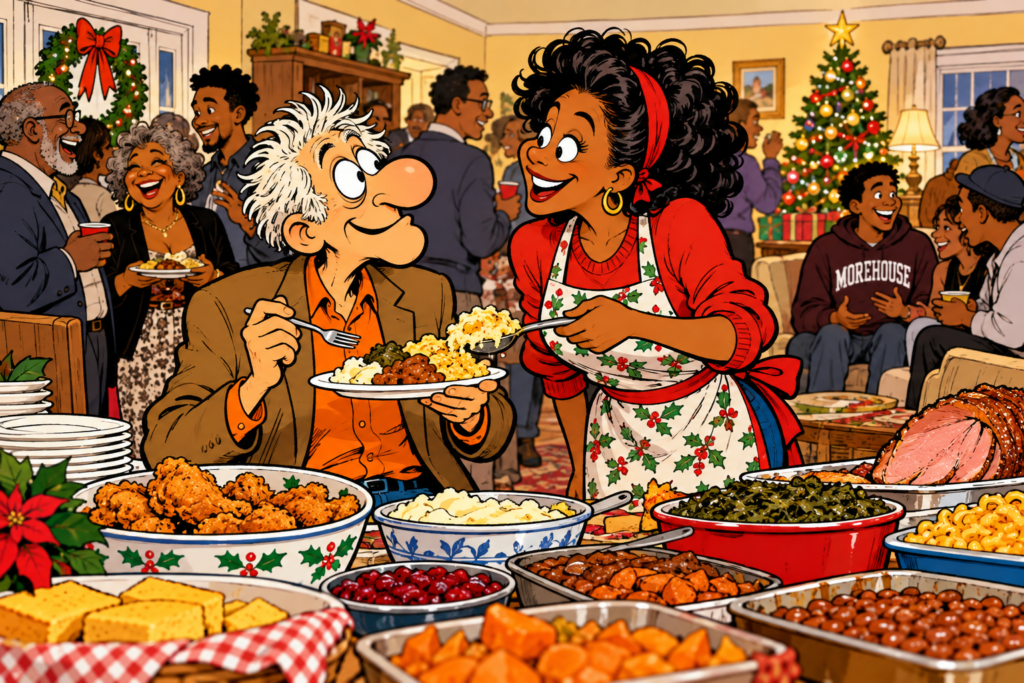
Then one Christmas, Maddie invited Red to a party at her house in East Point.
This was a significant social development.
Red considered himself reasonably sociable in those days. He knew plenty of people, belonged to organizations, went to business functions and could usually find somebody to talk to in a room full of strangers. What he did not seem to get invited to were actual parties, the kind somebody held at home because they wanted friends and relatives there rather than because a committee had reserved a ballroom and somebody needed to consume the shrimp before the ice melted.
So Red was excited. He was going to a Christmas party, at a house, because somebody had invited him.
Maddie apparently had either a very large family, a very large collection of friends, or had simply issued an invitation to most of East Point, because by the time Red got there the place was full. He was the only white fellow he remembers seeing, a fact he noticed because it was unusual for him, and then almost immediately discovered didn’t matter worth a damn. There were people everywhere, talking, laughing, eating, wandering from one conversation into another, and generally doing what people at a good Christmas party are supposed to do.
It reminded Red a little of Christmas at the Granary when Mother could somehow get fifty members of the family into a room that seemed to have been designed for twelve, except here most of the people were strangers to him.
That turned out to be part of the fun.
He met Maddie’s relatives and friends. He talked with young people attending Morehouse College. He wandered around introducing himself, listening to people, getting pulled into conversations, and discovering that his great expedition into private social life was going considerably better than expected.
Then he found the food.
Red Encounters the Christmas Table
Now a Southern Christmas table is not something a sensible person approaches timidly. Red recognized ham. He recognized collard greens, those great cooked-down leaves that have caused generations of Southern children to suspect that vegetables were invented as punishment before eventually discovering that, properly prepared, they were one of the reasons God created pork. There was sweet tea, of course, because civilization has certain minimum standards.
Red filled his plate quite happily.
Then he reached a pot containing something that, at first glance, appeared to be egg noodles.
This required further investigation.
The things in the pot were pale, curled, irregular and sufficiently noodle-like that an unwary man might have put a helping on his plate before asking the question that should always be asked before eating something you cannot positively identify.
Red asked.
They were chitlins.
Now, dictionaries, grocery labels and people who wish to conduct themselves properly in public may call these things chitterlings. Red grew up in North Carolina. They were chitlins. A chitterling may possibly exist somewhere above the Mason-Dixon Line, where people also do peculiar things to iced tea, but what sat in that pot in East Point, Georgia, was a chitlin.
For anybody who did not grow up around them, chitlins are cleaned and cooked pig intestines.
That information changed the appearance of the pot considerably.
Red had grown up on a farm. He was not delicate about pigs. He knew where pork came from and had participated in enough of the preliminary arrangements that he was under no illusion that bacon originated in little plastic packages at the grocery store. His own Grandmother Ward would probably have considered chitlins perfectly respectable food and may yet be waiting for him on Judgment Day with some questions about his upbringing.
But Red had limits. Pig intestines turned out to be one of them.
He did not make a speech. He did not recoil from the table or announce that generations of perfectly sensible Southerners had made a culinary error. He simply allowed the serving spoon to remain where it was and continued down the line toward territory with which he had a more satisfactory diplomatic relationship.
And this raises a question.
If you had been standing there at Maddie’s Christmas table, surrounded by people having a wonderful time, and discovered that the innocent-looking noodles were pig intestines, would you have tried them? Tell me.
What Red Remembers
The funny thing is that all these years later, the chitlins are not really what Red remembers most about Maddie’s Christmas party.
He remembers being invited.
He remembers walking into a house where he knew almost nobody and finding himself welcome anyway. He remembers talking with those Morehouse students, meeting Maddie’s family and friends, eating her Christmas dinner, and discovering an entire part of her life that had never been visible across a desk at the bank.
That may be the more interesting thing about Maddie herself.
At work she was the cheerful woman handling borrower reports. Spend enough years around her and other pieces appeared: Eastern Airlines, baseball, the farm, the farmers market, her daddy, that tremendous collection of jobs, and a house in East Point apparently capable of expanding at Christmas to accommodate a substantial percentage of the local population.
Red had thought he knew Maddie.
He knew the part of Maddie that crossed his path. There is a difference.
Maybe that is one reason the party stayed with him. A person can work beside somebody for years and still know only the version of that person who arrives at eight in the morning and sits on the other side of the office. Then one invitation opens a door and suddenly there are parents and children and ambitions and old traditions and college students and farms and relatives and Christmas tables and things in pots that should have been more clearly labeled.
The Old Git has lived long enough now to suspect that nearly everybody he ever knew was bigger than the portion of them he happened to encounter.
Maddie certainly was.
And if the Lovely Celeste ever decides that the Old Git’s education remains incomplete and puts a steaming bowl of chitlins in front of him, he intends to contemplate that profound observation while eating something else.