
Daddy had decided we needed a better class of cow, dear hearts, or at least a better class of cow arriving eventually on somebody’s supper table.
We had been using a Brahma bull. Now a Brahma is an impressive creature, all hump and hanging hide, with an expression suggesting he has been personally insulted by the entire human race. But Daddy was not raising cattle for their personality. The calves were coming out stringy, and what Daddy wanted was marbling. Marbling, friends. The sacred streak of fat running through the flesh of the faithful.
Daddy did not spend a great deal of time discussing this with the cows. He bought himself an expensive prize Hereford bull and expected that gentleman to attend to the matter through the usual agricultural procedures.
Shortly after Daddy brought him home, the damned bull disappeared.
Now think about that. You can misplace a pocketknife. Mama can lose her glasses while they’re sitting on top of her head. A man can misplace his temper, his hat, and his place in the hymnal all in one Sunday morning. But a Hereford bull is a substantial piece of the Lord’s creation. He’s red and white. He’s considerably larger than the average breadbox. He’s inclined to leave evidence when he goes somewhere. And still we looked, and we could not find Daddy’s livestock-improvement program anywhere.
That was more than an inconvenience, man. Daddy had paid good money. The bull had taken Daddy’s investment, his marbled-beef ambitions, and his reproductive responsibilities and departed for parts unknown.
So I decided to saddle up and conduct what I considered a proper search.
Linda and Red Go Bull Hunting
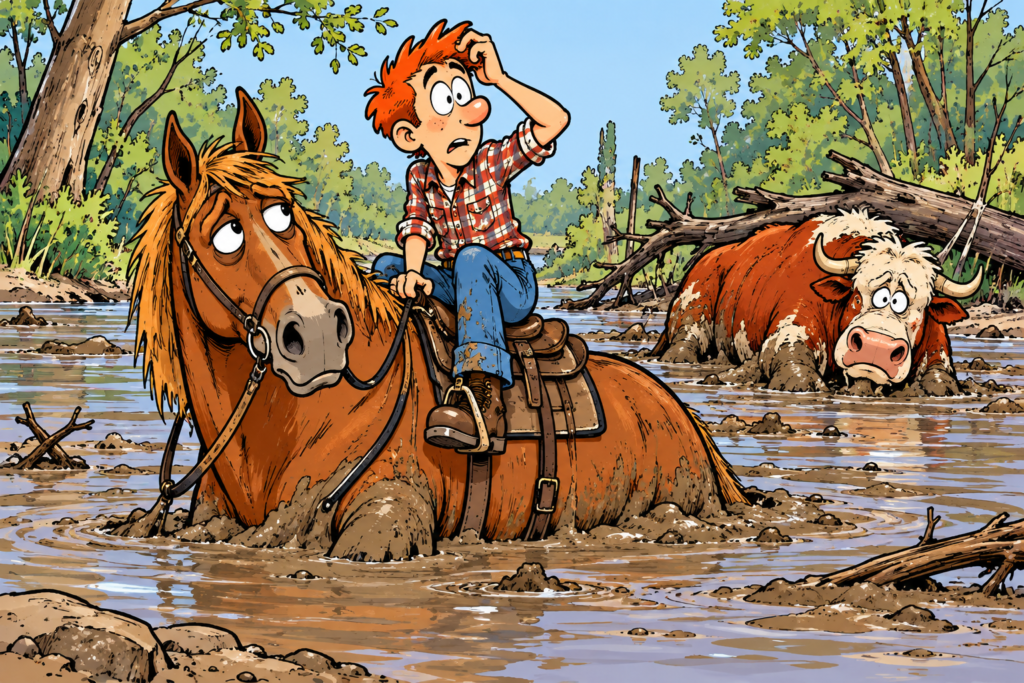
The horse available for this enterprise was Linda, one of our old workhorses. She was a big chestnut mare, swaybacked and broad through the middle, heavier and larger than Cotton, the horse I’d had back in Aventon. Linda was not the kind of horse that caused little girls to draw hearts around her picture. She looked like what she was: a farm animal that had spent a good part of her life pulling things human beings were too sorry or too weak to pull themselves.
What I did not appreciate at the time was that Linda had also spent those years accumulating information. She knew things about footing and mud and weight and balance and getting herself out of trouble that were not in my education. I was the human being, so naturally I assumed I was in charge. Linda, being a horse, was willing to humor me until circumstances required adult supervision.
We started hunting. I rode through the woods and through the swamp. I rode along the edges of the pastures in the lowgrounds. I rode through the fields where we grew corn and soybeans. I looked anywhere I could imagine a bull going, and several places where no self-respecting bull had any reason to go at all. Every so often I expected to see that red-and-white rascal standing somewhere looking innocent, because cattle have a marvelous gift for making their owner’s inconvenience appear to be entirely the owner’s problem.
We found woods. We found swamp. We found pasture, corn, soybeans, and a great deal of Durham County.
What we did not find was Daddy’s Hereford.
The Ladies of Fairntosh
Eventually my search carried Linda and me down along the Eno River, which separated our farm from Fairntosh Farm on the other side. In much of that country the riverbank rose like a little cliff, enough of one that you couldn’t ride a horse down one side and up the other unless you had grown tired of owning both the horse and your neck. After following it a while, I found a place where Linda could get down to the water and cross.
That opened an entirely new line of investigation. Fairntosh had a large herd of Black Angus cattle. And somewhere in the developing mind of young Red, a perfectly reasonable explanation presented itself. Perhaps Daddy’s bull had not become lost at all. Perhaps he had become socially ambitious.
I did not have Daddy’s knowledge of animal husbandry, but I knew enough about bulls to understand that a neighboring farm full of eligible Black Angus heifers might exert a certain attraction upon a recently arrived Hereford gentleman. Daddy was thinking about marbled beef. The bull might have been thinking about glamour girls.
So Linda and I crossed the Eno and went exploring around Fairntosh. I looked among the Angus cattle and everywhere else a visiting Hereford might go to introduce himself. I don’t know what I expected to find. Perhaps the rascal leaning against a fence smoking a cigarette and telling the Angus girls he owned property across the river. But there was no sign of him.
After a while I gave up and started home.
This should have been the uncomplicated part of the expedition. I had crossed the river once. All that remained was to cross it again.
Unfortunately, when I got back to the river, I couldn’t find the place where Linda and I had come over.
I rode along the bank looking for something familiar until I found another crossing that appeared even better than the first. The banks were low on both sides. The water was shallow. And underneath it I could see what looked like a nice sandy bottom. Nothing about the place announced danger. It looked considerably more accommodating than most of the river I had been riding beside.
So I nudged Linda into the water.
Linda Discovers Something Red Doesn’t
We had gone only a little beyond Linda’s body length when she began to sink into the sand.
At first I didn’t understand what was happening, because nothing dramatic announced it. The river wasn’t suddenly deep. The current wasn’t carrying us away. Linda hadn’t stumbled into a hole. She was simply going down.
Her feet disappeared farther into the bottom. Then more of her legs. And finally that big old chestnut mare had sunk until the sand and muck were up around her broad, flat belly, and I sat on top of her trying to understand how a perfectly ordinary sandy river bottom had started swallowing my horse.
I would like to tell you, dear hearts, that my farm upbringing immediately supplied the answer. I would like to tell you I recognized the danger, calmly evaluated our alternatives, and guided Linda to safety with the quiet competence of a young fellow destined for agricultural greatness.
Linda and I remember it differently. I didn’t know what the hell was happening, and Linda apparently did.
When she had sunk as far as she was willing to tolerate, she gathered herself and made a tremendous jump forward. Now this was not Trigger sailing magnificently across a canyon while Roy Rogers waved his hat. Linda was a heavy, swaybacked workhorse trying to pull four legs out of something that wanted to keep them, and she lunged forward only far enough to buy us a little more river.
Then she landed. She stood there a moment.
And she began sinking again.
About the time I settled myself enough to start thinking about this new predicament, Linda would gather herself and jump again. She would land a little closer to the bank, sink until the bottom had hold of her, and make another powerful lunge. I remember no wild thrashing. I remember no panic. She seemed to understand that whatever had her could be escaped a little bit at a time, and she kept doing what worked.
That is how we crossed the river, with an interesting division of labor. Linda handled locomotion, survival, and most of the thinking. I contributed by remaining approximately on top of the horse.
It was not the first time in my life that somebody else understood what was happening before I did, and it would damned sure not be the last.
Now here’s something I’d like to know from you. Have you ever had an animal know something before you did? A horse that wouldn’t cross somewhere, a dog that knew somebody was coming home, a cat that disappeared before the storm, or some other critter that made a decision you didn’t understand until later? Tell the Old Git what happened. Don’t dress it up. Just give us the story the way you remember it, because Linda has made me suspicious that we humans aren’t always the smartest animal in the conversation.
The Bull Wasn’t Courting Anybody
Finally Linda reached the low bank on our side, found solid footing, and walked us out. And once we were on ground that had the decency to stay where God put it, I turned around and looked back at the stretch of river we had just crossed.
And there was Daddy’s missing Hereford bull.
He was caught in the same mud and sand Linda and I had just come through, down near a fallen tree in the river. He wasn’t wandering around Fairntosh admiring the Black Angus ladies. He hadn’t found some undiscovered corner of our farm. He had not decided to abandon Daddy and seek his fortune elsewhere. The poor son of a gun had gotten into that river bottom and could not get himself back out.
Now rejoice with me for a moment at the glorious foolishness of how I found him. I had searched the woods. I had searched the swamp, the lowground pastures, the corn and soybean fields. I had crossed the Eno into Fairntosh because I had developed a theory about the bull’s romantic intentions. None of it worked. I found him because I couldn’t find my original crossing, picked the wrong place to come home, and rode my own horse straight into the same trouble that had swallowed Daddy’s expensive bull.
The theologians would have a word for that, and the word is Providence. Providence works in mysterious ways, dear hearts. But every now and then it gets tired of being mysterious and simply leads the fool into the same mud hole as the answer.
Daddy Gets His Bull Back
I rode home and reported to Daddy that I had finally found his bull.
Daddy and Uncle Burch got the little Ford F-100 tractor and took it down into the lowgrounds to pull the animal out of the river. I didn’t go with them, so I can’t give you the engineering specifications of the recovery operation, nor can I reproduce the language two grown farm men might have used while persuading an expensive Hereford to cooperate with a Ford tractor. I knew both men well enough, however, to suspect that Shakespeare was not heavily represented.
They succeeded. The bull came out. Daddy got his investment back. And eventually Daddy and Uncle Burch returned with one more piece of information for the young explorer who had located him.
The place where Linda and I had crossed the river was quicksand.
That was news to me.
Until then, quicksand belonged in the same general category as jungle headhunters and fellows swinging across ravines on vines. It was something that happened in the movies, usually to somebody wearing khaki and carrying a rifle. Nobody had mentioned that we kept a perfectly serviceable supply of it in the Eno River behind our own farm, much less that I might spend part of an afternoon sitting on top of a horse while she extracted both of us from it.
That changed my understanding of the whole crossing. I had thought Linda was behaving strangely because something strange was happening. Daddy and Uncle Burch supplied the name afterward, but Linda hadn’t needed the name. She met the problem through her feet and legs and belly, and whatever years of being a workhorse had left inside her told her enough to act.
The Old Horse Knew Before the Boy Did
That’s the part that has stayed with me all these years.
Linda couldn’t have explained what quicksand was. I doubt she had a word for the damned stuff in her horse vocabulary. She couldn’t tell me whether she had met something like it before or whether she was simply responding to what she felt beneath her. What she could do was recognize that ordinary walking no longer worked, and change what she was doing.
I was supposedly the intelligent creature in the partnership. I could reason. I could construct theories. I could cross a river because I suspected a Hereford bull might be attracted to Angus heifers, and later tell Daddy where I had found his missing property. But while the actual problem was happening, all that wonderful human equipment did me very little good, because I hadn’t yet understood the Encounter.
Linda didn’t need to understand it the way I did. She needed to get out of it.
There may be something important hiding in that distinction. We like to believe that explanation comes first: identify the problem, understand it, develop the solution, and then act. A great deal of human progress undoubtedly happens exactly that way. But sometimes something meets us before we have a name for it, and some piece of accumulated experience recognizes the pattern before the conscious mind catches up.
Old Linda couldn’t lecture on any of that.
She just kept jumping.
The Wrong Crossing
There is another piece of this story that bothers me, in a good way, now that I’m an Old Git looking backward at it.
I had done almost everything right in my search for the bull. I had covered the farm. I had checked the places cattle might wander. I had expanded the search to the river, and finally crossed onto Fairntosh because I had a reasonable theory about where an unattached bull might go.
All that intelligent searching failed.
What succeeded was getting lost.
I couldn’t find my original crossing, so I chose another one. I chose badly. That mistake put Linda and me into the quicksand, and escaping the quicksand put me in exactly the position from which I could finally see the thing I had spent all that time trying to find.
I’ve lived long enough now to wonder how many other things work that way. We remember the plans that succeeded because they make a tidy story, but some of the most consequential things in a life begin when the plan goes to hell. You take the wrong road. You meet the wrong person. You lose the job you meant to keep. You build something that doesn’t work. You discover that the sandy bottom under you isn’t a bottom at all. While it’s happening, you call it a mistake, because that’s the only pattern you can see.
Years later, sometimes, you discover there was a bull lying beside it.
Have You Ever Found Your Bull?
That’s the question I’d like to throw over the fence to you, dear hearts.
Have you ever found something important precisely because something went wrong? Maybe you missed a turn, lost a job, broke something, failed at something you were certain would work, or wound up somewhere you had absolutely no intention of going. At the time it may have looked like nothing but trouble. But somewhere in the middle of the trouble was a person, an idea, an opportunity, or a discovery you would otherwise have missed.
If you’ve got one of those stories, send it to us. Don’t polish it into a lesson first. We’re particularly interested in what actually happened: what you were trying to do, what went wrong, what you stumbled into instead, and when, perhaps years later, you finally saw the connection.
Throw your story over the fence. Your wrong turn may be exactly the Encounter somebody else around here needs to hear about, and it doesn’t have to arrive as a finished story. Give us the pieces you remember and we’ll worry at them together.
As for Red, he went looking for a bull and came home having learned something about quicksand, old horses, wrong turns, and the limitations of being the smartest animal in the saddle.
And Linda?
Linda got us home.