
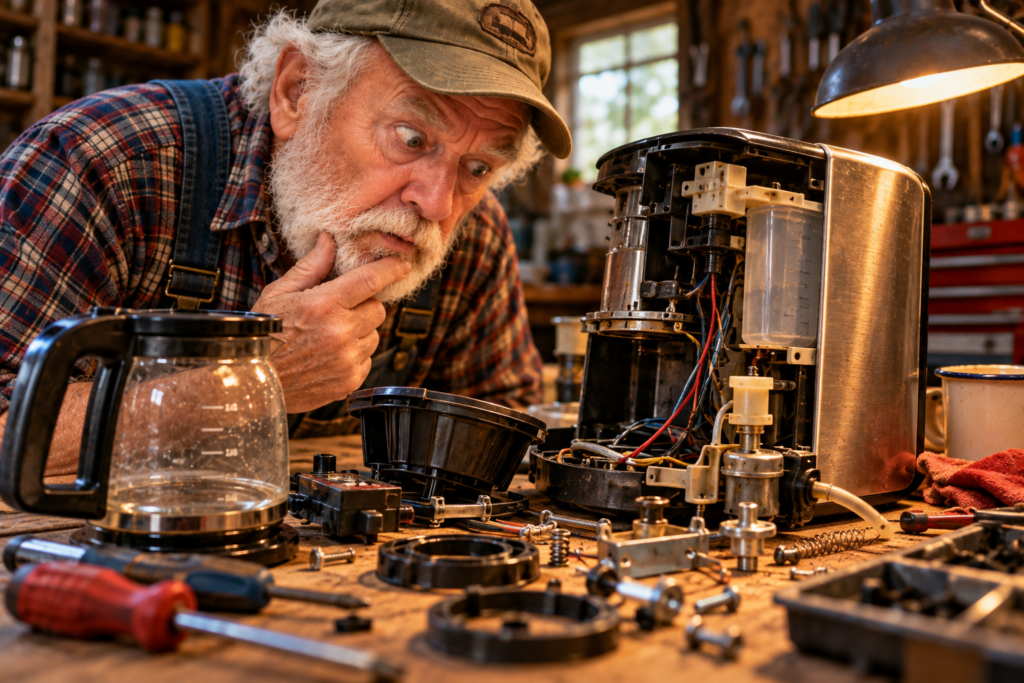
I have been taking things apart for as long as I can remember.
That statement may cause some alarm among people who own things I happen to be standing near, so perhaps I should qualify it. I don’t necessarily mean taking them apart with a screwdriver. I have certainly done my share of that, sometimes even managing to get all the pieces back together without having several mysterious parts left over. What I mean is that when I encounter something I don’t understand, sooner or later I want to know what is going on inside it.
How does this damn thing work?
I suspect I’m not alone.
You may have asked the same question about a lawn mower, an election, a carburetor, a marriage, a computer, a toilet, the stock market, your left knee, or that little thing on the restaurant table that holds the packets of artificial sweetener. The complexity of the object doesn’t seem to matter much. Something happens, we don’t quite understand why it happens, and curiosity gets hold of us.
I rather like curiosity. It has gotten me into trouble from time to time, but so have most of the other things I’ve enjoyed.
Knowing What It Is Isn’t the Same as Knowing How It Works
We live surrounded by things we know perfectly well without understanding them in the slightest.
I am writing this on a computer. I know what a computer is. I can operate one reasonably well, although the computer and I occasionally have differing opinions about which of us is doing the operating. I know that when I press a key, a letter appears on the screen. I also know there is a long and complicated explanation of what happens between my finger moving and that letter appearing, most of which would cause my eyes to glaze over before somebody reached the third semiconductor.
That doesn’t prevent me from using the thing.
Most of life works that way. You turn a faucet and water comes out. You press the brake pedal and several thousand pounds of automobile rather obligingly stop moving. You swallow an aspirin and, with any luck, your headache improves. We learn the relationship between what we do and what happens next, and that’s usually enough.
Until it isn’t.
The faucet starts making a noise. The brake pedal feels funny. The aspirin doesn’t help. The computer does something it has never done before and displays a message apparently written by somebody who considers English an unnecessary extravagance.
That’s when the familiar thing becomes interesting again. You look at it and wonder: How does this damn thing actually work?
Start With the Part You Can See
One of the problems with asking how something works is that the question can become enormous almost immediately.
Take a toilet. That’s a wonderfully ordinary machine. Most of us have operated one successfully for many years without professional training. Push the handle, various watery events occur, and the evidence disappears. Civilization has benefited enormously from this arrangement.
But suppose one morning the handle goes down and nothing happens. Now you’re interested.
You take the lid off the tank and discover a little world that has been conducting business three feet from you for years without ever requesting your attention. There’s water, a float, a valve, a chain, a rubber contraption at the bottom, and perhaps several other objects whose purpose is not immediately apparent. Move the handle and something lifts something else. Water goes somewhere. The float moves. Another valve opens. Eventually everything returns to where it started.
Well, I’ll be damned.
It isn’t magic after all. It’s a collection of pieces, each doing something fairly modest, arranged so that one event causes another. You may not understand every piece yet, but now you have somewhere to look.
Most Things Are Made of Other Things
That sounds embarrassingly obvious until you begin paying attention to it.
A bicycle is made of parts. So is a restaurant. So is a football game. So is a business, a family reunion, a traffic jam and the federal government, although in that last case identifying what some of the parts are supposed to accomplish may require additional research.
The physical things are easiest to see. A bicycle has wheels, pedals, a chain, handlebars, bearings, brakes and a seat designed by somebody whose opinion of the human backside may deserve examination. Each piece has relationships with other pieces. Push the pedal and the crank turns. The crank moves the chain. The chain turns the rear wheel. The wheel pushes against the ground, and off you go until something else in the arrangement persuades you to stop.
Once you see the pieces and their relationships, bicycle becomes more than the name of the whole object.
The same trick works on things that aren’t machines.
Take a restaurant. Somebody orders food. That information has to reach somebody who prepares it. The ingredients have to be available before the order arrives. The finished food has to find its way back to the correct customer. Money has to move in the opposite direction. Dirty dishes have to become clean dishes, tables occupied by one group eventually have to become available to another, and somewhere in the middle of all this somebody has to notice that table twelve still hasn’t received its soup.
That’s a machine of sorts too. Not because people are machine parts, but because there are relationships among the parts of the activity, and changing one relationship can alter what happens elsewhere.
Now my curiosity has somewhere else to wander.
What Happens If I Poke This Bit?
This is where asking how something works becomes considerably more interesting than simply learning its name.
Once you begin seeing the pieces, you can start wondering about the relationships among them. What causes what? What depends on what? Which piece is necessary, and which one is there merely because somebody has always done it that way? What happens if one piece disappears? What happens if it gets bigger, smaller, faster, slower, cheaper, stronger, or moves somewhere else?
This is also where perfectly respectable examination can deteriorate into fooling around, which I recommend from time to time.
A child does this naturally. Give a child something unfamiliar and, provided no adult has yet said, “Don’t touch that,” the child turns it over, shakes it, pokes it, opens whatever will open, and attempts to determine whether any portion of it will fit into another portion where the designer clearly had no intention of putting it.
The child is investigating relationships.
Somewhere along the road to becoming responsible adults, many of us learn to stop doing that. We learn what the thing is called, what it is for, and the approved way of using it. That is undoubtedly helpful for maintaining an orderly society, but I wonder whether we give up something useful when we quit asking what all the other bits might do.
I never entirely got over it.
Then Comes the Dangerous Question
Once you understand a little about how something works, another question tends to sneak in: Why does it have to work that way?
That one can be troublesome.
The answer may be perfectly good. The thing works that way because somebody spent thirty years discovering all the other ways that don’t work. There may be laws of physics involved, safety requirements, costs, materials, human anatomy, or some other stubborn piece of reality that has no interest whatsoever in our wonderful new idea.
But occasionally the answer is less impressive: We’ve always done it that way.
Now my ears perk up.
That doesn’t mean the old way is wrong. Things frequently become customary because they work rather well. But once the explanation for a particular piece or relationship becomes merely “that’s how it’s done,” I want to know who decided it, what problem they were solving, whether the problem still exists, and what would happen if somebody moved the furniture around.
There’s that damned wonder again.
Your World Is Full of Things I Don’t Understand
This is where you become considerably more interesting to me than my toilet.
You know how things work that I have never encountered. Maybe you spent your life repairing aircraft, teaching third grade, laying concrete, raising children, running a warehouse, selling insurance, programming computers, nursing patients, growing tomatoes, driving trucks, or doing something I don’t even know exists.
You have seen pieces and relationships I haven’t.
More importantly, you have probably encountered things in your own world that you don’t completely understand either. Perhaps you’ve wondered about them for years. Perhaps everybody around you accepts something as normal and you’re the irritating person who keeps asking why. Perhaps you’ve figured out how something works but can’t understand why anybody designed it that way in the first place.
Bring me those.
That’s part of what Your Ideas is for on this website. You don’t need to have solved the problem. You don’t even need to be certain there is a problem. Tell us what you’re looking at, what it does, and what about it makes you wonder.
Maybe somebody else who visits the site knows the answer. Maybe your question reminds another person of something apparently unrelated. Maybe it bumps into one of my experiences. Maybe one of the artificial-intelligence systems I work with can help us find research, history, patents, or another field where somebody has already encountered something similar.
Or perhaps we’ll all stare at it for a while and remain completely mystified. We have a place for that too.
Have Another Look
The next time you use something familiar, give it a few extra seconds before you move on. You don’t have to dismantle the toaster, and I would particularly discourage doing so while it remains connected to the wall. Just look at what happens.
What moved? What caused it to move? What had to happen first? What happens next? Why is that piece shaped that way? Who decided it belonged there? What would happen if it weren’t?
You don’t need to answer all those questions. One good question is enough to send you wandering somewhere interesting.
And if, somewhere along the way, you find yourself staring at something you’ve seen a thousand times and suddenly wondering How does this damn thing work?, come back and tell us about it.
I’d like to have a look too.