
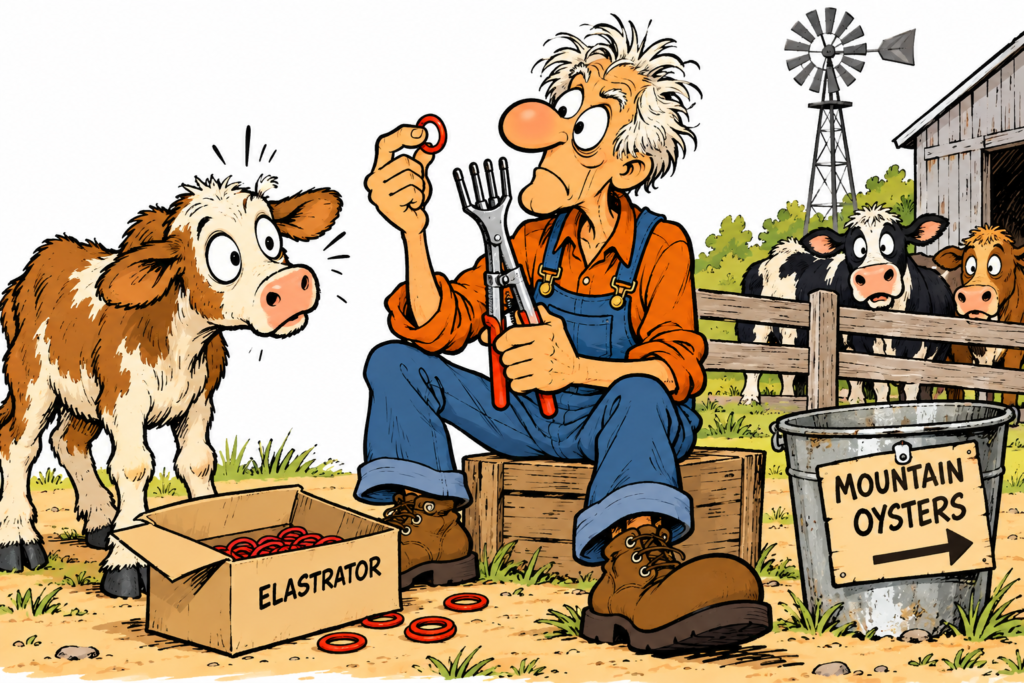
Once upon a time, there was a farm just outside Durham, North Carolina, where the Old Git spent a good portion of his childhood before he was either old or sufficiently accomplished in gittishness to deserve the title. It was a proper farm, meaning that it contained horses, mules, cows, pigs, chickens, children, mud, manure, machinery capable of removing portions of a person without consulting him, and enough daily work to prevent anybody from developing romantic notions about agriculture. Later, when Brother John was old enough to become involved, there were sheep as well, but by then the agricultural enterprise had already achieved sufficient diversity to keep a boy occupied.
The farm also came with Sylvester, the tenant farmer, who was a man of somewhat relaxed attitudes toward both labor and property ownership. He could be remarkably difficult to locate when there was ordinary work to be done, although he had apparently developed several private enterprises requiring enough energy to prove that laziness, like beauty, may depend largely upon who is doing the looking. His children were Kirk’s friends and they played together, but Sylvester himself occupied a somewhat different position in the boy’s understanding of the world.
One of Sylvester’s private enterprises was moonshine. He manufactured his product from corn mash and sold the resulting spirits to the shot houses around Durham, informal drinking establishments where the licensing arrangements were probably somewhat less burdensome than those encountered by legitimate businessmen. The interesting feature of Sylvester’s operation, at least from Daddy’s point of view had Daddy known the full accounting procedure, was that some of the corn Sylvester used belonged to Daddy and had originally been intended for pig feed.
Sylvester apparently saw no serious difficulty here because, after the alcohol had been distilled out of the mash, he returned the residue to the pigs as still slop. Thus, under the Sylvester Theory of Inventory Control, nothing had actually been stolen. Corn had temporarily left the agricultural system, undergone a modest change in form, produced a salable intermediate product, and then returned to its originally intended customers. The pigs may have had opinions about this accounting system, but nobody asked them.
The Old Git has spent a considerable portion of his adult life around accounting, audits, collateral, inventory, and businessmen who could explain with considerable sincerity why something that had disappeared had not really disappeared at all. It occurs to him now that perhaps his professional education started somewhat earlier than he had previously credited, but that is another story. This one concerns another farm procedure in which certain things disappeared and, unlike Daddy’s corn, did not always come back.
A Certain Problem With Young Males
A farm containing cows and pigs eventually encounters a management problem having to do with young males and their developing interest in the opposite sex. Left entirely to their own devices, young bulls and boars will devote a considerable portion of their growing years to pursuing the young damsels of their respective species around the premises with intentions that require very little explanation to anybody who has survived adolescence. The farmer, however, has a different business plan. He would prefer that the young gentleman spend less time contemplating feminine wiles and more time standing peacefully in a pasture, eating whatever has been provided and converting it into additional pounds of animal. Those pounds eventually went either to market or to the farm’s own butcher, and pounds were therefore a considerably more useful agricultural product than romance.
There was a procedure for adjusting the young male’s priorities, and for calves Daddy and Kirk used an Elastrator. A person in his thirties or forties who did not grow up around livestock may reasonably wonder what an Elastrator is, and there is no reason he should know. It is a small hand-operated farm tool with handles and four metal prongs at the working end. A very small, very strong rubber ring is stretched over those prongs, and when the handles are squeezed, the prongs spread apart, stretching that little ring until it becomes large enough to pass over portions of a young bull calf’s anatomy that the bull calf would have preferred to keep outside it.
The Old Git owns one today, and it sits on a bookshelf in his office. There are objects a man inherits that remind him fondly of childhood: photographs, Bibles, pocket watches, perhaps an old fishing lure that belonged to his father. Then there is the Elastrator, which produces a somewhat different class of memory.
Daddy’s Little Herd of Drunkards
The operation usually took place around feeding time because that was when the cattle came up from the lowground pastures to the barn. Their evening attraction was silage, chopped green corn that had been packed into an underground trench and covered so it would ferment and keep for feeding later. Fermentation does things to corn, and the cows apparently approved of what it did. As the silage aged it became an increasingly attractive dish to the bovine population, and it has occurred to the Old Git only much later that Daddy may have been operating a sort of cattle cocktail hour without either a liquor license or a bartender. Every evening the clientele wandered up from the lowgrounds, assembled around the trough, and received its daily ration.
This also brought the calves within reach. The first requirement was catching one while he was still young enough to be manageable. The second was getting him onto his back. The third was keeping him there, which became particularly interesting if his mother remained emotionally committed to the proposition that strangers should not be turning her child upside down. Daddy had only one good arm, so he would hold the calf with that one while Kirk contributed an arm of his own. That left Kirk with one additional arm, which was fortunate because the Elastrator did not operate itself.
Once the calf was on his back, Kirk squeezed the handles, spreading those four prongs and stretching the rubber ring as far as the contraption would allow. He then had to temporarily reassign the hand that had been helping hold the calf, locate the young gentleman’s two future instruments of romance, carefully gather them together, and maneuver the stretched ring over them until everything that needed to be on one side of the rubber band was, in fact, on that side. Then he released it, the band snapped tightly into place, and the calf generally responded with an immediate demonstration that the procedure had been noticed. Daddy and Kirk released him and the little fellow would come straight up from the ground, kicking and hopping away with the unmistakable impression that something of consequence had just occurred behind him.
Over time, the rubber ring stopped the blood supply to the enclosed tissue. The unwanted equipment dried up and eventually fell away, leaving behind a young steer with substantially reduced romantic ambitions and a greater willingness to concentrate on dinner. The rubber bands fell off too, but nobody went around the pasture collecting them. They weren’t that expensive, but somewhere in the offices of the company that manufactured Elastrators there must have been a fellow who understood that this was an unusually fine business model: sell the farmer the tool once, then arrange matters so that a little piece of the product falls into the pasture every time he uses it. The Old Git, who has spent much of his life thinking about businesses, can appreciate that, although he would not particularly want to be the calf.
Now put yourself beside Kirk for a moment. Daddy has one good arm holding a calf on the ground. Kirk has one arm helping him, an Elastrator in the other hand, and somewhere nearby is a mother cow who has not been given a detailed explanation of the procedure. Would you take the Elastrator, or would you suddenly remember an urgent appointment somewhere else? Tell me.
Then There Were the Pigs
If the calf operation sounds somewhat primitive, dear hearts, you have not yet met the hog department. Young pigs that had reached the stage at which this procedure was performed were called shoats, and their treatment did not involve an Elastrator. It involved Kirk, Sylvester, a can of burnt motor oil, and a pocketknife.
For reasons never entirely clear to Kirk, Sylvester could be difficult to find for many ordinary varieties of farm work but was quite willing to appear when it was time to “cut the pigs.” There was no colorful Southern metaphor involved in that expression. They cut the pigs.
Kirk and Sylvester would go to the pig barn and drive the shoats together into one stall, then take them out one at a time for treatment. Kirk would flip the selected pig onto its back and hold the rear legs while trying to keep the rest of the animal reasonably stationary, sometimes using a knee against the pig’s body because a shoat receiving this sort of personal attention did not ordinarily regard cooperation as one of its responsibilities.
Sylvester would arrive carrying the can of used engine oil and his pocketknife, and that knife was sharp. It wasn’t merely pocketknife sharp, or sharpen-it-on-a-stone-and-cut-a-piece-of-rope sharp. It was surgically sharp, razor sharp, the sort of knife whose edge made it apparent that Sylvester, whatever his other shortcomings as an agricultural employee, took this particular assignment seriously.
With Kirk holding the pig, Sylvester would kneel beside it and feel around the hog’s rump until he located what he was after. Then came one clean slice through the skin. The oval gland underneath was exposed, Sylvester cut the cord attaching it, and the removed piece went into the can of motor oil. He brushed a generous amount of that same used oil onto the cut, and the two of them released the pig, which generally departed for the main stalls at considerable speed and considerable volume. Then Kirk and Sylvester went back for the next customer and did the whole damned thing again.
Sylvester’s Compensation Plan
Kirk eventually learned that Sylvester had a special name for the pieces accumulating in that can. He called them mountain oysters, and, more remarkably, he considered them a delicacy. This explained something that had previously been puzzling: Sylvester’s unusual willingness to participate in this particular farm chore. He took the mountain oysters as his pay for cutting the pigs.
Kirk does not remember how Sylvester cleaned them afterward, or even whether he did, and there are some areas of historical inquiry into which the Old Git feels no obligation to venture merely for the sake of completeness. He does know that many people in his part of the country ate them, enjoyed them, and sometimes spoke with considerable enthusiasm about how delicious they were. Kirk never joined the congregation, and even now the thought produces a shudder.
But imagine being that boy for a moment. You’ve spent the afternoon upside down over one unhappy shoat after another while a man with a razor-sharp pocketknife performs surgery beside your knee. At the end of the job, you discover that the bucket of removed parts isn’t waste at all. It’s his paycheck, and apparently later it is going to be supper. What would you have thought the first time somebody explained mountain oysters to you? Tell me.
Nothing Ever Quite Left the Farm
There is something about all of this that the Old Git did not see when he was the boy holding the calf or the pig, and there was no reason he should have seen it. He was doing chores. Daddy needed another arm, and Kirk had arms. Sylvester needed somebody to hold the shoat still, and Kirk was apparently judged suitable for the position.
But sitting here all these years later, with that Elastrator on the bookshelf, the pieces begin bumping into one another. That farm was forever changing one thing into another. Corn went into the silage trench green and came back fermented enough to bring the cows home voluntarily every evening. Grass and feed went into cattle and pigs and came back as pounds that could be sold or butchered. Daddy’s corn wandered into Sylvester’s moonshine operation, produced whiskey somewhere along the way, and returned to the pigs as still slop. A young bull calf surrendered certain future interests and became a steer more inclined to eat than court. The shoats lost something as well, except in their case the missing parts entered an entirely different economic system and went home with Sylvester.
The boy did not stand there contemplating systems; he was trying to keep from getting kicked. That distinction matters, because it would be tempting now to turn the farm into some grand early education in circular economies, transformation, inventory, business models, or whatever else an eighty-four-year-old man might discover after staring backward long enough. That would make the story neater than the life was.
What the boy actually got was experience. He got Daddy with his one good arm, cattle coming up from the lowgrounds for silage, the feel of an Elastrator in his hand and what happened when that little rubber ring snapped shut. He got shoats squirming under his knee, Sylvester’s knife, burnt motor oil, and the discovery that one man’s discarded pig parts could be another man’s compensation package. None of it arrived carrying a label explaining what use it might have later. It simply happened, and whatever remained from it went wherever such things go.
Now an Elastrator sits quietly on a bookshelf in the Old Git’s office, looking for all the world like an obsolete little farm tool that ought to have been thrown away years ago. Yet when he looks at it, the whole damned farm can still come walking through the door with it: Daddy, the cows coming up from the lowgrounds, the silage trench, Sylvester, the shoats, the knife, the oil, the moonshine, and a boy with one free hand trying to do what his father needed him to do.
Maybe that’s one of the things old objects are good for. They don’t merely remind us what they were; every now and then, if we worry at them long enough, they remind us what we were becoming while we were using them.